That dark, ominous puddle on your driveway can certainly make your heart sink. For many BMW owners, though, it's a familiar sight. BMW oil leaks are not a sign of poor manufacturing. They are a direct consequence of the incredible heat generated by their high-performance engines. Over time, that intense heat takes a toll on critical components. Think of the rubber gaskets and seals inside your engine like a rubber band left out in the sun. They eventually become dry, brittle, and lose their ability to create a tight seal.
Why Your BMW Might Be Leaking Oil
Seeing that unsettling dark spot under your car is often the first sign of a very manageable maintenance issue. While you absolutely need to address it, it does not mean your Ultimate Driving Machine is on its last legs. Think of the engine's many seals and gaskets as unsung heroes, constantly battling extreme conditions. They live in a world of high temperatures and dramatic pressure changes every single time you drive. This constant cycling from cold to hot and back again is what wears them down. Most gaskets are made from specialized rubber or cork, designed to perfectly seal two metal surfaces together. But after tens of thousands of miles of heat exposure, these materials naturally degrade. They lose their flexibility, shrink, and harden. Once a gasket becomes brittle, it can no longer form that perfect seal, and a little bit of oil starts to seep out. This is a predictable and normal part of owning a finely tuned, high-performance vehicle. It is not so much a sudden, catastrophic failure as it is the natural aging of hardworking parts. Knowing this can help you shift from a feeling of panic to a mindset of proactive maintenance.
Common Signs of a BMW Oil Leak
So, how can you be sure that spot on the ground is actually an oil leak from your BMW? Beyond the obvious puddle, there are a few other key clues to watch for. Spotting these signs early can help you fix a small problem before it turns into a major headache. Before we dive into the specific parts that fail, let's cover the symptoms. This quick guide will help you play detective and figure out what your BMW is trying to tell you.
| Symptom | What You Might See or Smell | Most Likely Cause |
|---|---|---|
| Burning Oil Smell | A sharp, acrid smell after a drive, especially when you come to a stop. | Oil is dripping onto hot components like the exhaust manifold and vaporizing instantly. |
| Visible Engine Smoke | Faint blue or white smoke wafting up from under the hood when the engine is warm. | This indicates a more significant leak where oil is hitting a very hot surface. |
| Low Oil Warning | The iDrive system or dashboard frequently alerts you that your oil level is low. | While some oil consumption is normal, repeated warnings are a classic sign of a leak. |
| Engine Grime | A dark, greasy buildup of gunk on the engine block or on the plastic under-tray. | This is the tell-tale sign of a slow leak, where oil mixes with road dust over time. |
Paying attention to these signs is the first step. If you notice any of them, it’s time to take a closer look under the hood to pinpoint the source.
The Top 5 Sources of Most BMW Oil Leaks
While it's true that high-performance engines put stress on their components, most BMW oil leaks do not happen randomly. They almost always trace back to a handful of usual suspects. These are the parts that live in the engine bay's hottest, highest-pressure neighborhoods, and that constant abuse eventually takes its toll. Knowing where leaks typically start helps you have a much more productive conversation with your service technician. Think of it like this: your engine is sealed up with a team of hardworking gaskets and seals. They're made of specialized rubber designed to stay flexible and keep oil where it belongs. But after thousands of heat cycles, going from cold to scorching hot and back again, that rubber gets cooked. It becomes hard, brittle, and eventually shrinks just enough to break the seal. That's when the drips begin. The core forces at play are simple but powerful, as this chart shows. It really boils down to three things: relentless heat, general wear from use, and plain old age. Together, they are the reason these critical gaskets and seals eventually give up.
The Valve Cover Gasket
If there's a "greatest hit" of BMW oil leaks, the valve cover gasket is it. This gasket seals the valve cover to the very top of the engine, keeping oil contained as it splashes around the valvetrain. Its location is its downfall. Sitting right on top, it gets baked by engine heat more than almost any other part. When this gasket fails, oil seeps out and trickles down the side of the engine block. The tell-tale sign? A strong burning oil smell that wafts into the cabin when you're stopped at a light. That's the unmistakable scent of leaking oil hitting the searing hot exhaust manifold and instantly turning to smoke.
The Oil Filter Housing Gasket
Coming in at a close second is the oil filter housing gasket, or OFHG as it's known in enthusiast circles. This little part seals the metal housing for the oil filter to the side of the engine block. It’s a critical junction because, on many BMW engines, both hot oil and engine coolant flow through this same housing. A bad OFHG can cause two different problems. The most common is an external leak, which coats the front of your engine and serpentine belt in a grimy film. The more serious issue is an internal failure, where oil and coolant start to mix. If you ever open your oil cap and see a milky, coffee-with-too-much-creamer sludge, a failed OFHG is a likely culprit.
"Had a leak from my oil filter housing gasket on my E90. Didn't look like much at first but made a huge mess over the front of the engine and on the belts. Getting it fixed stopped the leak and a potential belt failure." - A BMW owner on the E90Post forum.
This is a perfect example of why you can't ignore it. That "small" oil leak can saturate and destroy your engine's main drive belt, leading to a much bigger problem.
The Oil Pan Gasket
Down at the very bottom of the engine, the oil pan gasket is tasked with sealing the oil pan (the reservoir holding all the engine oil) to the engine block. While it does not face the same blistering temperatures as the valve cover gasket, it endures a lifetime of vibrations and heat cycles that eventually cause it to harden and leak. An oil pan gasket leak is the classic cause of that dreaded oil spot on your garage floor or driveway. Because it's the lowest seal on the engine, gravity ensures any leaking oil goes straight down. This repair can be surprisingly time-consuming. On many models, the front subframe has to be dropped just to get to the pan, making the labor cost far exceed the price of the gasket itself.
The Rear Main Seal
The rear main seal is the big one. It's tucked away deep between the back of the engine and the transmission, and its only job is to seal the end of the spinning crankshaft. Getting to it is a major operation. You'll know this one is leaking if you see oil dripping from the bell housing, which is the area where the engine and transmission bolt together. Replacing this seal requires removing the entire transmission from the car. Because of the massive amount of labor involved, it's one of the most expensive oil leak fixes. It's so involved, in fact, that many owners wait to do it at the same time as a clutch job to avoid paying for the same labor twice.
Turbocharger Oil Lines
On the newer turbocharged BMWs, we have another potential leak source: the oil lines for the turbo. These small lines are responsible for feeding high-pressure oil to the turbocharger's bearings, which spin at incredible speeds. These lines and their small O-rings are bolted directly to the turbo, one of the hottest parts of the entire car. This extreme, localized heat cooks the seals, causing them to become brittle and leak over time. It's a particularly well-known issue on the popular N20, N54, and N55 engines.
Why Some BMW Models Are More Prone to Leaks
You might notice that certain BMWs have a bit of a reputation when it comes to oil leaks, and it’s not just a myth. While BMW's engineering philosophy centers on performance, the specific design choices for certain engines create unique quirks and, yes, common failure points. It’s not necessarily a flaw, but more of a trade-off. In the quest for lighter cars, better fuel efficiency, and more power from smaller engines, engineers use complex turbo systems and advanced materials. Over time, these very innovations can become the source of a leak. Let's look at a couple of well-known examples.
The Notorious N20 Four-Cylinder Engine
If you drove a BMW from the 2010s, like a 328i or an X3, there's a good chance it had the N20 four-cylinder engine. This little engine is a marvel of power and efficiency, but it’s also known for a particularly frustrating issue: it can burn a lot of oil. Many owners mistake this for a typical oil leak, but the problem is often happening inside the engine. Instead of a simple drip from a bad gasket, the real culprits are often internal parts like the piston rings or valve stem seals. When these components wear out prematurely, oil slips past them and is burned up with the fuel. The classic signs are a puff of blueish smoke from the exhaust and your low-oil light coming on way too often. This is not a rare problem, either. The N20 and similar engines, especially in models like the F20 1 Series from around 2012-2019, became infamous for their thirst. It was not uncommon for owners to report adding a full liter of oil every 1,000 to 1,800 kilometers (that's roughly every 600-1,100 miles). That's far from normal and means constantly checking the dipstick between scheduled oil changes. If this sounds familiar, you can read more about this specific BMW oil consumption issue in this helpful guide from AutoDoc.
Issues with the Powerful N63 V8
Step up to the big leagues with models like the 5 Series, 7 Series, and X5, and you’ll find the potent N63 V8. This engine introduced an innovative "hot-vee" design, where the turbochargers are nestled inside the "V" between the cylinder banks. This is great for performance and packaging, but it creates an oven-like environment for every seal, gasket, and hose nearby. The intense, trapped heat essentially cooks the rubber and plastic components, causing them to break down much faster than they would in a conventional engine. We see the same patterns over and over again with the N63:
- Valve Stem Seals: These are a classic failure. The heat bakes them until they're hard and brittle, letting oil seep down into the cylinders after you shut the engine off. If you see a puff of blue smoke when you start your car in the morning, this is the likely cause.
- Turbocharger Oil Lines: The lines that feed oil to and from the turbos are right in the heart of the heat zone. Their seals get brittle and start to leak.
- Crankcase Vent Hoses: Made of plastic, these hoses become incredibly fragile with the constant heat cycles. They eventually crack, causing both oil leaks and other frustrating performance problems.
"The N63's hot-vee layout is an engineering marvel for packaging and performance, but it puts a tremendous thermal load on everything around it. Gaskets and seals that would last 100k miles on another engine might only last 60k on this one."
This is exactly why having a technician who truly knows these engines is so important. An expert who has seen dozens of N63s can spot the early signs and recommend preventative work that a general mechanic might completely overlook. Properly fixing these BMW oil leaks means understanding the unique engineering, and its consequences, behind each specific model.
How to Investigate an Oil Leak at Home
You do not need a professional lift or a full mechanic's toolkit to start playing detective with a suspected oil leak. A few simple checks right in your own driveway can tell you a lot. The goal here is not to get your hands dirty with a repair, but to gather some solid clues that will help a professional technician pinpoint the problem much faster. Think of yourself as the first responder on the scene. You’re just collecting evidence to build a case, which makes the final diagnosis from an expert more accurate and efficient.
Start with the Obvious Checks
Your first step is the easiest. Before you assume the worst, you need to confirm you're actually losing oil. Modern BMWs make this pretty straightforward.
- Check Your Oil Level: Depending on the year of your BMW, you'll either have a classic dipstick under the hood or an electronic oil level sensor you can check right from your iDrive screen. A single low reading is not necessarily a cause for panic, but if you're constantly topping it off, you've almost certainly got a leak or an internal consumption issue.
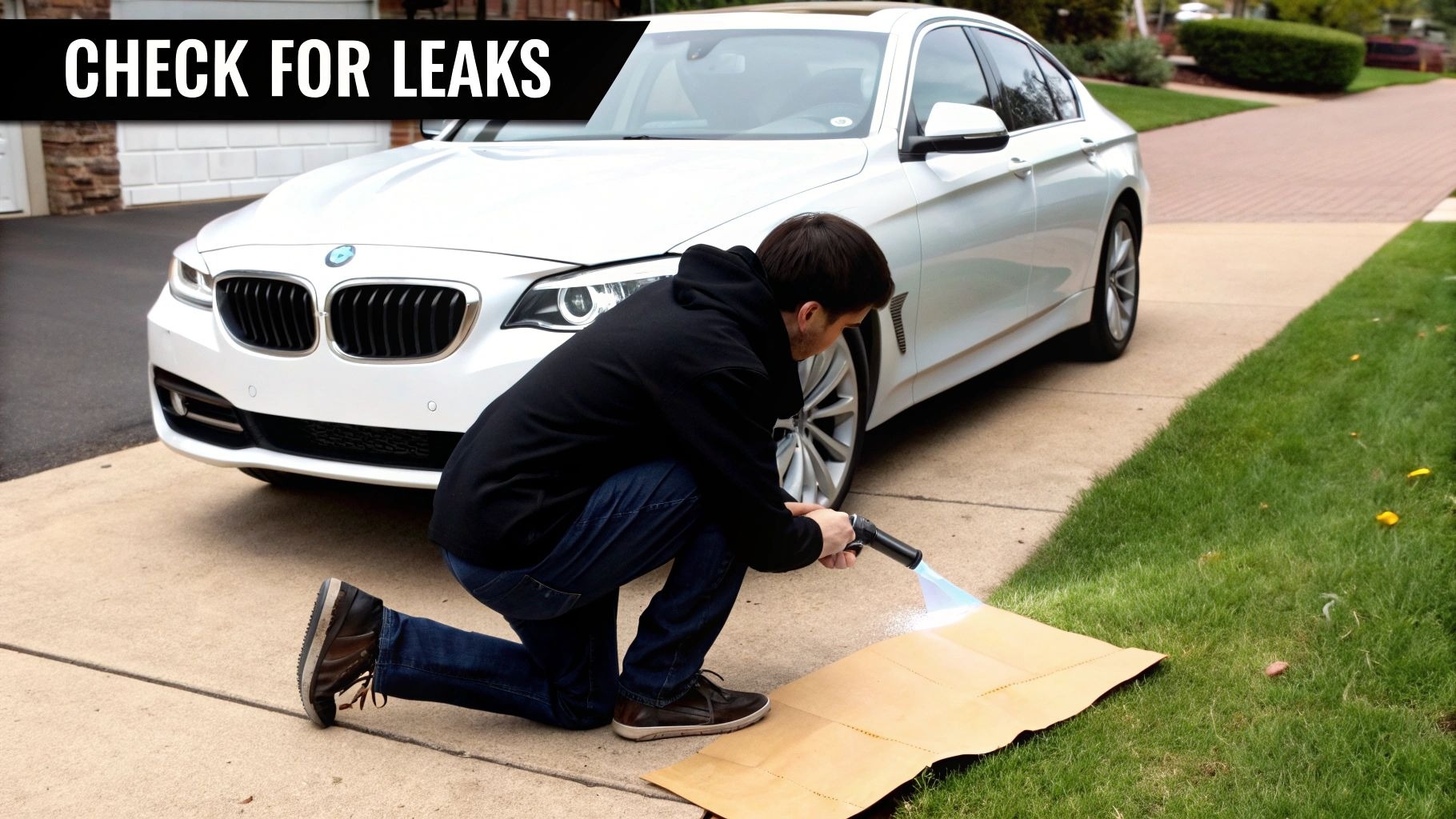
- The Cardboard Trick: This is an old-school diagnostic for a reason. It works. Slide a big, clean piece of cardboard under the engine bay when you park for the night. In the morning, any drips will stand out clearly. The location of the spots on the cardboard gives you a general idea of where the leak is coming from: the front, middle, or back of the engine.
Visually Inspect the Engine Bay
Next, grab a bright flashlight and pop the hood. Your mission is to hunt for any signs of fresh, wet oil or old, caked-on grime that looks like oily dirt. Even if you can't name every part, you can easily spot where the mess is concentrated. Start by looking around the top of the engine at the plastic valve cover, then trace your way down the sides of the engine block. One of the most common sources of a BMW oil leak, the oil filter housing, is typically located near the front of the engine, so give that area a close look.
The most valuable information you can bring to the shop is location. Telling your service advisor, "I see fresh oil on the passenger side of the engine, near the top," is infinitely more helpful than just saying, "I think my car is leaking oil."
Identify the Fluid
Finally, take a closer look at whatever drips you found on the cardboard. Not every puddle under your car is engine oil, and figuring out what it is can save you a lot of unnecessary stress.
- Engine Oil: Will look light brown to black and feel very slippery between your fingers.
- Coolant/Antifreeze: Usually a vibrant blue, green, or pink. It also has a noticeably sweet smell.
- Transmission Fluid: Tends to be a reddish-brown color with a slightly different, almost acrid smell.
- Water: If it's clear and has no odor, it's just condensation from your A/C system, which is completely normal on a warm day.
By running through these simple checks, you replace guesswork with facts. You can walk into a service center like Habberstad BMW of Bay Shore with confidence, armed with useful information that helps our technicians get straight to the root of the problem. This saves diagnostic time and ensures a precise, effective repair.
What to Expect for BMW Oil Leak Repair Costs
Let's talk about the bottom line. Seeing an oil spot under your BMW is one thing, but figuring out what it's going to cost to fix is what really matters. It helps you budget, plan, and avoid any nasty surprises when the final bill comes. The total cost for any repair always boils down to two key factors: the price of the replacement parts and the amount of labor time it takes to get the job done. Here's the interesting thing about BMWs: the failing part, whether it's a gasket or a seal, is often surprisingly affordable. The real cost comes from the labor. These cars are masterpieces of tight packaging, and that legendary German engineering means a technician often has to move a lot of other components out of the way just to reach the one that needs replacing.
Breaking Down the Repair Bill
A classic example of this is the oil pan gasket. The part itself might only set you back $50. But on many models, especially those with the xDrive all-wheel-drive system, replacing it is a major operation. It often requires dropping the entire front subframe just to gain access. Suddenly, that "cheap" part turns into a job that can take a skilled technician anywhere from 5 to 8 hours. As you can imagine, that's where the majority of the cost comes from. To give you a realistic idea of what to expect, we've put together a table outlining the estimated costs for the most common oil leaks we see.
Estimated Repair Costs for Common BMW Oil Leaks
This breakdown of typical repair costs can help you budget for potential maintenance. Keep in mind that these are ballpark figures and can vary based on your specific model, location, and the service center's labor rates.
| Leak Source | Estimated Parts Cost | Estimated Labor Hours | Total Estimated Cost Range |
|---|---|---|---|
| Valve Cover Gasket | $50 - $150 | 2 - 4 hours | $400 - $800 |
| Oil Filter Housing Gasket | $30 - $80 | 2 - 5 hours | $350 - $900 |
| Oil Pan Gasket | $50 - $100 | 5 - 8 hours | $900 - $1,800+ |
| Rear Main Seal | $40 - $100 | 8 - 12+ hours | $1,500 - $2,500+ |
These numbers give you a solid starting point for understanding what a professional repair might involve.
DIY vs. Professional Service
Looking at those figures, especially the labor costs, it’s natural to think, "Maybe I can do this myself." For a mechanically inclined owner, a simpler job like a valve cover gasket might be a manageable weekend project. But it is not without significant risks. If a gasket is not installed perfectly, it’s just going to leak again. Worse, you could accidentally damage something else in the process, turning a manageable repair into a much bigger headache.
"Had a friend try to DIY his oil pan gasket. He cross-threaded a bolt and ended up cracking the aluminum oil pan. The 'cheap' fix cost him an extra grand." - A BMW owner on a Bimmerfest forum.
Ultimately, choosing a certified BMW service center is an investment in your car and your own peace of mind. Our professional technicians at Habberstad BMW of Bay Shore use genuine BMW parts, have the specialized tools required for the job, and back up their work with a warranty. It's the only way to be certain the repair is done right the first time, protecting your Ultimate Driving Machine for the miles ahead.
Why Trust a Certified BMW Specialist for Repairs?
So, you've spotted an oil leak. Now comes the most critical decision: where do you take your BMW to get it fixed? While you might be tempted to call your local general mechanic, the intricate engineering of a BMW really calls for a specialist's touch. Going to a certified BMW service center is not just about paying for the logo. It's an investment in getting the job done right the first time. Think about it. An independent shop might see a leaky BMW once in a while. Our certified technicians, on the other hand, live and breathe these engines every single day. They know the common culprits by heart, from the N20's tendency to consume oil to the N63's heat-related gasket failures. That kind of hands-on, daily experience leads to faster, more accurate diagnoses.
The Right Tools for a Precision Machine
A huge piece of the puzzle is having access to proprietary BMW diagnostic equipment. These are not the generic code readers you can buy online. They're sophisticated tools that communicate directly with your car's complex computer systems. It’s like the difference between a doctor using a stethoscope and ordering an MRI. One gives you a general idea, the other shows you exactly where the problem is. On top of that, we only use Genuine BMW Parts. These components are engineered to the exact, strict tolerances your vehicle was built with. An aftermarket gasket might be a few bucks cheaper, but if it fails in six months, you're back to square one, paying for the same repair all over again.
As one owner put it on a popular BMW forum, "The dealership fixed my oil filter housing gasket leak, and the peace of mind knowing they used genuine parts and guarantee their work is priceless. No more worrying about drips on the driveway."
That sentiment says it all. A certified repair is not a temporary patch. It's a long-term solution.
It's More Than Just Fixing the Leak
We get it. Being without your car is a major hassle. A quality service experience is about more than just turning wrenches. It's about respecting your time and making the entire process as painless as possible. That's why top-tier service centers offer conveniences like:
- Loaner Vehicles to keep your life moving.
- Shuttle Services for easy drop-offs and pick-ups.
- Easy Online Scheduling to work around your calendar.
Ultimately, taking your car to a specialist for a BMW oil leak is about protecting your investment. It ensures the performance, safety, and value of your vehicle are preserved by technicians who know it inside and out.
When your BMW demands expert care, trust the team that understands its every nuance. Habberstad BMW of Bay Shore is ready to help. Schedule your service appointment online and let our certified professionals restore your Ultimate Driving Machine to its peak condition.