How to Diagnose Check Engine Light: Your Guide to a Quick Diagnosis
January 30 2026 - dave@phatoon.com
That little amber light on your dash just lit up. Now what?
Seeing the check engine light can definitely ruin your morning commute, but it doesn't automatically mean your BMW is headed for a catastrophic failure. Think of it as your car's way of saying its onboard diagnostic (OBD-II) system has logged a potential problem. Before you start imagining worst-case scenarios and expensive repair bills, take a breath. A few simple, methodical checks can often give you immediate answers or, in some cases, even fix the issue right away.
You're not imagining it; these lights seem to be coming on more often. A recent CarMD report found that nearly 20% of drivers surveyed had their check engine light on, a number that's almost doubled from previous years. It's a common part of modern vehicle ownership.
These simple observations arm you with crucial information, whether you plan to diagnose further yourself or bring your vehicle to a professional.
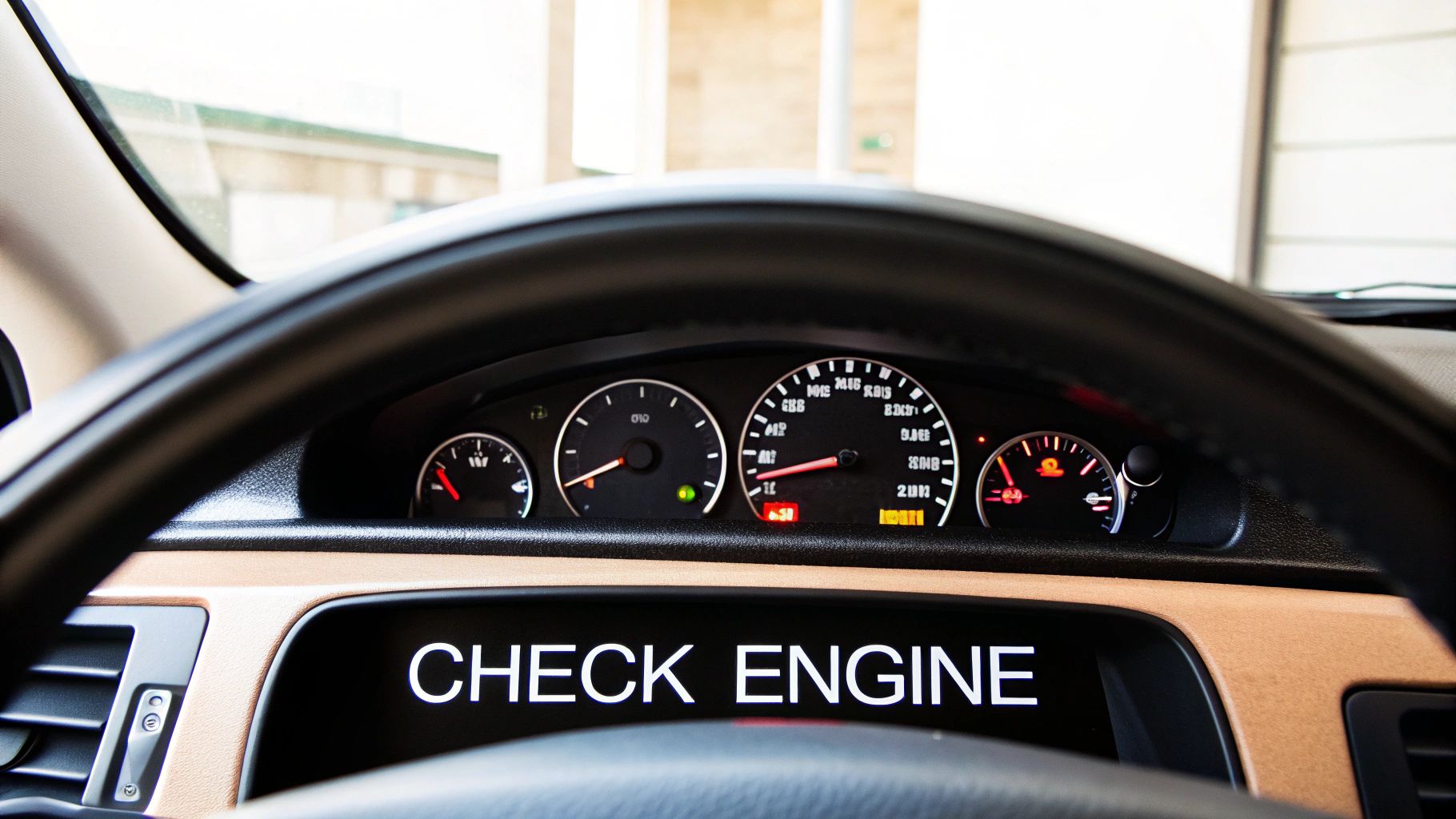 Alright, you’ve done the initial walk-around and nothing obvious is jumping out at you. Now it's time to get some real data. Your BMW has a powerful computer system that logs very specific faults, and an On-Board Diagnostics (OBD-II) scanner is your key to unlocking that information.
Think of it as having a direct line to your car's brain. It lets you see the same initial error codes that a professional technician at our shop would see first.
And don't worry, this step is way less intimidating than it sounds. You don't need some thousand-dollar professional rig for this part. There are plenty of affordable scanners and Bluetooth adapters that work perfectly for reading basic codes.
Alright, you’ve done the initial walk-around and nothing obvious is jumping out at you. Now it's time to get some real data. Your BMW has a powerful computer system that logs very specific faults, and an On-Board Diagnostics (OBD-II) scanner is your key to unlocking that information.
Think of it as having a direct line to your car's brain. It lets you see the same initial error codes that a professional technician at our shop would see first.
And don't worry, this step is way less intimidating than it sounds. You don't need some thousand-dollar professional rig for this part. There are plenty of affordable scanners and Bluetooth adapters that work perfectly for reading basic codes.
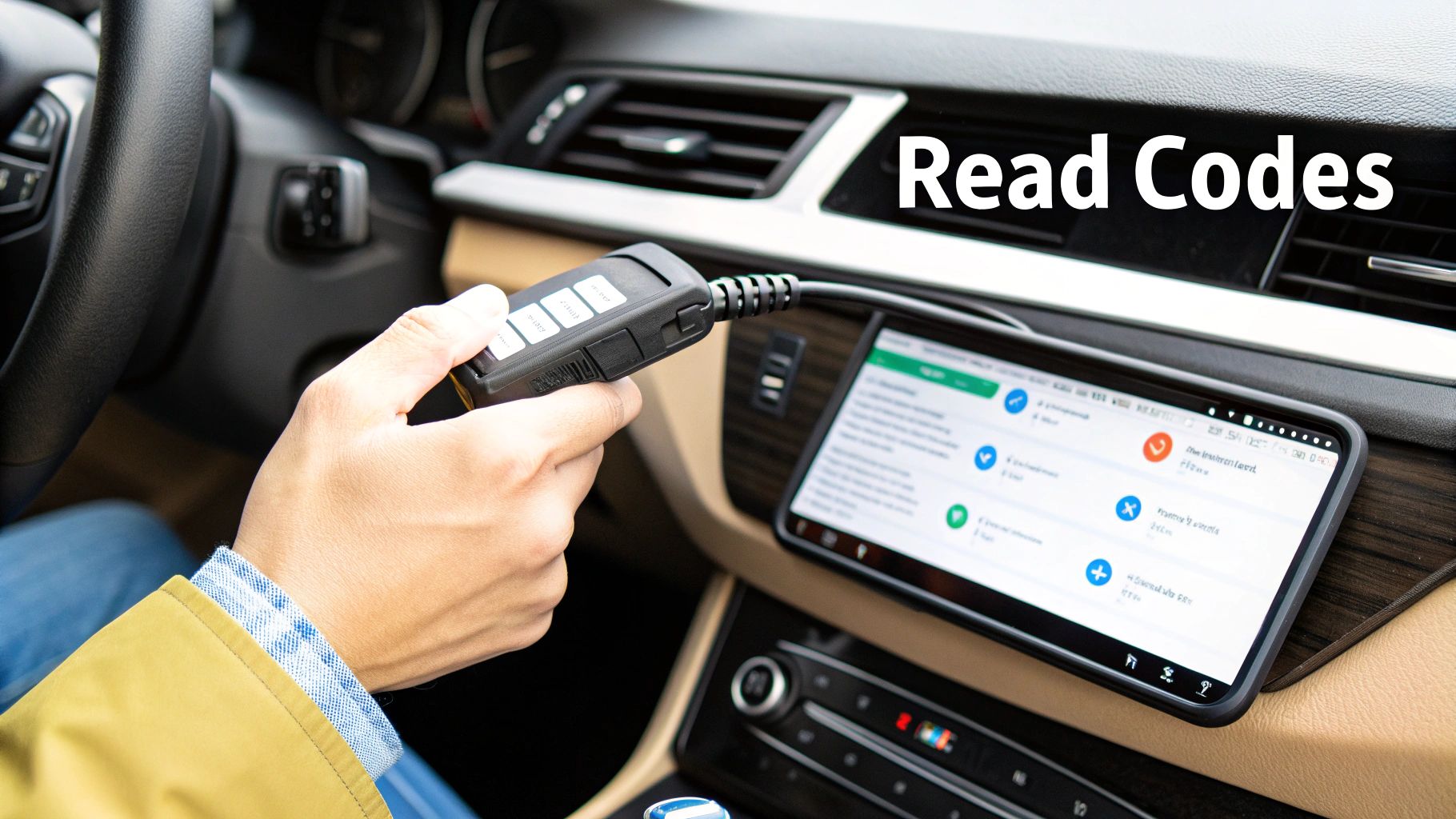 Alright, you've plugged in a scanner and pulled a code from your BMW’s OBD-II port. Now what? That string of letters and numbers is your first real clue about what’s going on under the hood, but it's not the final answer.
While there are literally thousands of potential codes, a handful show up far more often than others. We're not trying to make you a master technician overnight. The idea is to give you some context, so when you see a specific code, you'll have a better idea of what it means for your car's performance and your wallet. Knowing a code points to an oxygen sensor, for instance, helps connect the dots to the poor gas mileage you've been noticing.
Alright, you've plugged in a scanner and pulled a code from your BMW’s OBD-II port. Now what? That string of letters and numbers is your first real clue about what’s going on under the hood, but it's not the final answer.
While there are literally thousands of potential codes, a handful show up far more often than others. We're not trying to make you a master technician overnight. The idea is to give you some context, so when you see a specific code, you'll have a better idea of what it means for your car's performance and your wallet. Knowing a code points to an oxygen sensor, for instance, helps connect the dots to the poor gas mileage you've been noticing.
Think of this table as a starting point. It's not an exhaustive list, but it covers the greatest hits.
Armed with this basic knowledge, that check engine light transforms from a vague, anxiety-inducing symbol into a concrete starting point for a solution. You're now prepared to have a much more informed conversation if you decide to bring your BMW to us at Habberstad BMW of Bay Shore for a professional diagnosis.
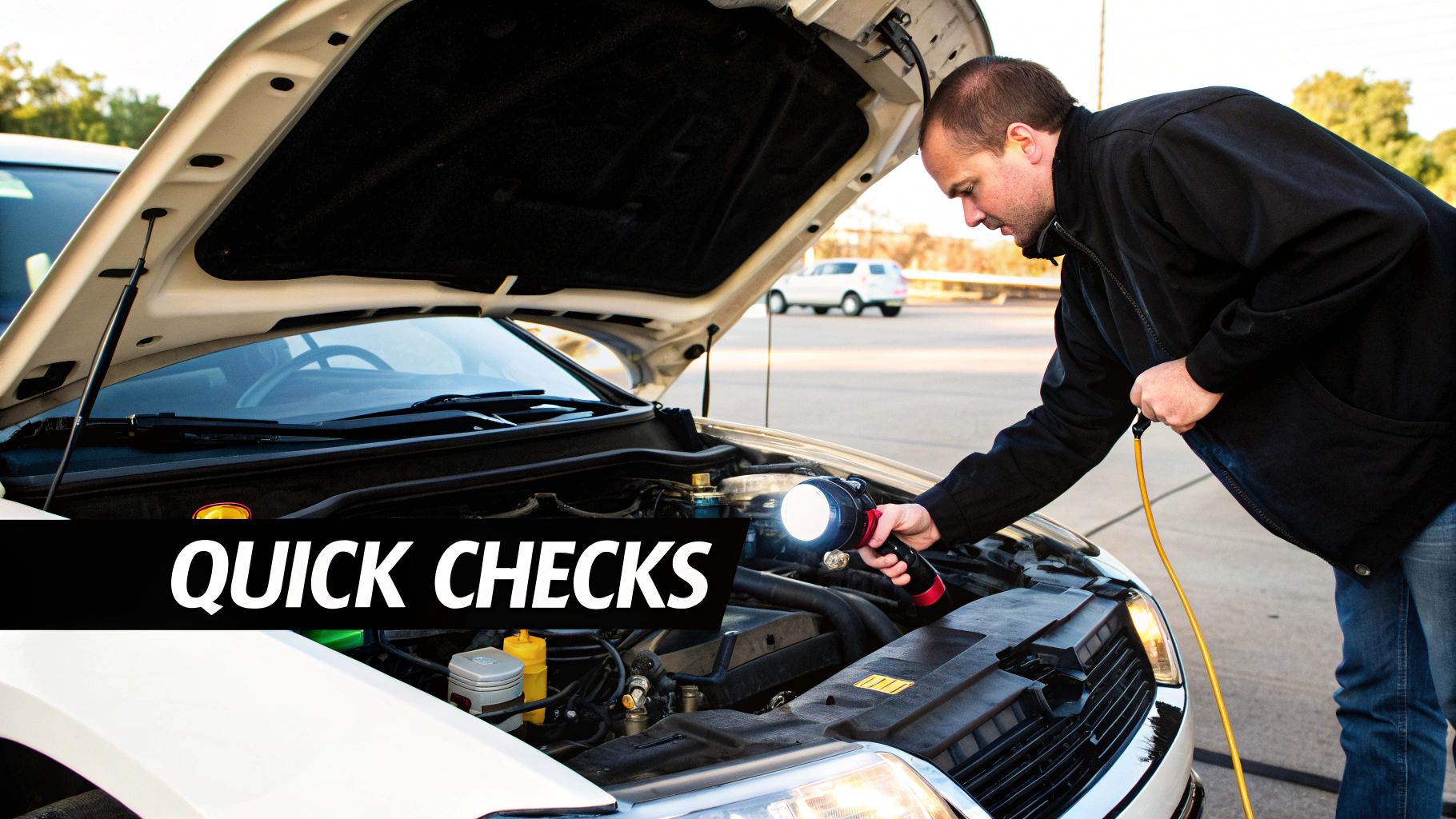
Once you have a diagnostic code, you have a solid lead. But before you book a service appointment, popping the hood for a few simple visual checks can give you even more context. You don't need to be a mechanic to spot something that's obviously out of place. This quick look-around might even reveal an easy fix.
Take a look around the engine bay. Your goal is to spot anything that looks damaged, disconnected, or leaking. Focus on the basics first. Are there any hoses that look brittle, cracked, or bulging? A split hose is a classic cause of a vacuum leak, which is a common trigger for a "System Too Lean" code.
 It’s tempting, isn’t it? Just put a little piece of tape over that glowing light and pretend it’s not there. Out of sight, out of mind. The problem is, ignoring a check engine light is one of the single most expensive mistakes a BMW owner can make.
Think of that light as your vehicle's early warning system. It’s a critical alert designed specifically to save you from bigger headaches, and much larger repair bills, down the road. When it comes to vehicle maintenance, procrastination almost never pays off.
It’s tempting, isn’t it? Just put a little piece of tape over that glowing light and pretend it’s not there. Out of sight, out of mind. The problem is, ignoring a check engine light is one of the single most expensive mistakes a BMW owner can make.
Think of that light as your vehicle's early warning system. It’s a critical alert designed specifically to save you from bigger headaches, and much larger repair bills, down the road. When it comes to vehicle maintenance, procrastination almost never pays off.
When your DIY efforts hit a wall or the problem feels bigger than you can handle, trust the experts. The certified technicians at Habberstad BMW of Bay Shore have the advanced tools and brand-specific experience to accurately diagnose and resolve any issue, making sure your BMW performs exactly as it should. https://www.habberstadbmwofbayshore.com
Start with the Basics: What Your Senses Tell You
Your first diagnostic tools are your own eyes and ears. No fancy equipment needed just yet. Is the light solid or is it flashing? This is the most critical first question. A flashing light is an urgent warning, often signaling a severe engine misfire that could be dumping unburned fuel into your exhaust system. If you see this, pull over as soon as it's safe and turn off the engine to prevent serious damage to your catalytic converter. If the light is steady, the situation is less critical. You have some time to investigate. Now, pay close attention to how your BMW is behaving. Do you hear any new or unusual noises? Does the engine sound rough when you're stopped at a light? Do you feel a hesitation or a noticeable drop in power when you accelerate? These clues are incredibly valuable for narrowing down the cause. For a quick summary, here are the immediate actions you should take as soon as that light appears.Immediate Actions for Your Check Engine Light
| Action | Reason | Time to Complete |
|---|---|---|
| Check the Light's Behavior | A steady light is a general alert. A flashing light signals a severe issue requiring you to stop driving immediately. | 5 seconds |
| Tighten the Gas Cap | A loose or faulty gas cap is a very common and simple-to-fix trigger for the check engine light. | 1 minute |
| Listen for New Noises | Squealing, grinding, or knocking sounds can provide clues about the specific system that's having a problem. | 2-3 minutes |
| Note Any Performance Changes | Rough idling, poor acceleration, or decreased fuel economy helps pinpoint the problem's severity and origin. | During your drive |
Don't Ignore the Warning
Even if your BMW seems to be driving perfectly fine, a steady check engine light should never be ignored. What starts as a minor issue, like a failing oxygen sensor, can snowball into a much more expensive repair, like a damaged catalytic converter, if you put it off for too long.A steady check engine light is an alert, not an immediate emergency. A flashing light, however, signals a serious issue that requires you to stop driving to prevent significant engine damage.By taking these initial steps, you're gathering important context. Knowing if the gas cap was loose or if the engine started running rough right after the light came on helps you, or one of our certified technicians here at Habberstad BMW of Bay Shore, diagnose the root cause far more efficiently. It's the first logical step toward getting your ultimate driving machine back to its peak performance.
Using an OBD-II Scanner to Read the Codes
Alright, you’ve done the initial walk-around and nothing obvious is jumping out at you. Now it's time to get some real data. Your BMW has a powerful computer system that logs very specific faults, and an On-Board Diagnostics (OBD-II) scanner is your key to unlocking that information.
Think of it as having a direct line to your car's brain. It lets you see the same initial error codes that a professional technician at our shop would see first.
And don't worry, this step is way less intimidating than it sounds. You don't need some thousand-dollar professional rig for this part. There are plenty of affordable scanners and Bluetooth adapters that work perfectly for reading basic codes.
Finding and Using the OBD-II Port
Every single vehicle made since 1996 has a standardized OBD-II port. In your BMW, you'll almost always find this trapezoid-shaped port under the dashboard on the driver's side, usually near the steering column or just above the pedals. You might need to crouch down a bit, but it’s designed to be accessible. Once you’ve found the port, the process is pretty simple:- Plug in the Scanner: Make sure the engine is off, then firmly connect your OBD-II scanner to the port. It only fits one way.
- Power On: Turn your key to the "On" position. This powers up the car's electronics, but don't actually start the engine.
- Retrieve Codes: Just follow the instructions for your specific scanner or app. It will link up with your BMW’s computer and show you any logged Diagnostic Trouble Codes (DTCs).
Understanding the Codes You See
The codes you get back will look like a jumble of letters and numbers, something like "P0301" or "P0420." It might seem cryptic, but each character has a specific meaning that helps narrow things down.- The First Letter: This points to the system with the fault. 'P' is for Powertrain (engine, transmission), which is where most check engine light issues live. You might also see 'B' for Body, 'C' for Chassis, or 'U' for Network issues.
- The Numbers: These get more specific. In a code like P0301, the '030' section points to a generic engine misfire, and that final '1' tells you the problem is in cylinder number one.
Retrieving a DTC is the single most important step in any DIY check engine light diagnosis. It turns a vague, frustrating warning light into a specific, actionable clue that points you right to the system that needs attention.You now have the same starting point a professional mechanic does. Instead of just guessing, you have a specific code that cuts the list of potential problems from hundreds down to just a handful. This makes you a much more informed owner, especially if you decide it's time to bring it in for professional service.
Decoding Common BMW Trouble Codes
Alright, you've plugged in a scanner and pulled a code from your BMW’s OBD-II port. Now what? That string of letters and numbers is your first real clue about what’s going on under the hood, but it's not the final answer.
While there are literally thousands of potential codes, a handful show up far more often than others. We're not trying to make you a master technician overnight. The idea is to give you some context, so when you see a specific code, you'll have a better idea of what it means for your car's performance and your wallet. Knowing a code points to an oxygen sensor, for instance, helps connect the dots to the poor gas mileage you've been noticing.
Problems With Your Emissions And Airflow
Many of the most frequent culprits behind a check engine light are tied to your BMW’s incredibly sophisticated emissions and engine management systems. These components all work in concert to keep the engine running at peak efficiency while minimizing its environmental impact.- Oxygen (O2) Sensor Failure: Your O2 sensors are crucial for fuel economy. They constantly measure the amount of unburned oxygen in the exhaust, feeding that data to the engine computer so it can fine-tune the fuel mixture. When one goes bad, you’ll almost certainly see a drop in MPG and could easily fail your next emissions test.
- Mass Airflow (MAF) Sensor Issues: The MAF sensor's job is to tell the engine computer exactly how much air is coming into the engine. If it gets dirty or fails, that data becomes unreliable, leading to classic symptoms like rough idling, stumbling during acceleration, and just plain bad fuel efficiency.
The Infamous Catalytic Converter Code
Seeing a code like P0420 ("Catalyst System Efficiency Below Threshold") is enough to make any owner's heart sink, and for good reason. The catalytic converter is a vital, and expensive, part of your exhaust that turns harmful pollutants into less nasty gases. But here’s a critical piece of insider knowledge: the converter itself often isn't the original problem. More frequently, something else, like a bad O2 sensor or a persistent engine misfire, has caused the converter to fail. This is why just swapping the part without finding the root cause is a recipe for disaster. You'll just end up with another failed converter down the line.Understanding the code is just the first step. It tells you which system is reporting a fault, but it rarely tells you why. That’s where a professional diagnosis comes in, to pinpoint the true cause and prevent repeat repairs.
Ignition System Faults
If a component in your ignition system fails, you're going to feel it. This system is responsible for the spark that ignites the air-fuel mixture, and when it's not working right, the symptoms are impossible to ignore.- Bad Spark Plugs or Ignition Coils: These two work as a team to deliver a powerful spark. When a spark plug wears out or an ignition coil starts failing, it can lead to an engine misfire. You'll feel this as a distinct shaking or stuttering, especially at idle or when you're trying to accelerate. A misfire is one of the most common reasons for a flashing check engine light.
Common Diagnostic Trouble Codes and What They Mean
This table breaks down some of the most common Diagnostic Trouble Codes (DTCs) you might encounter, what they typically mean, and how urgently you should address them.| DTC Code | Common Meaning | Potential Problem Area | Urgency Level |
|---|---|---|---|
| P0171 | System Too Lean | MAF sensor, vacuum leak, O2 sensor | Medium |
| P030X | Engine Misfire Detected | Spark plugs, ignition coils, fuel injector | High (if flashing) |
| P0420 | Catalyst System Efficiency | Catalytic converter, O2 sensor | Medium to High |
| P0135 | O2 Sensor Heater Circuit | Oxygen sensor or wiring | Medium |
Inspecting Wires and Connections
Next, turn your attention to the electrical system. A modern BMW is a complex network of sensors and wires all working together, and a loose or frayed wire can easily disrupt the signals these sensors send to the computer, triggering a fault code. Gently tug on the electrical connectors you can easily see. Do they feel loose or look corroded? Look for wiring that might have been chewed by a rodent, more common than you'd think, or rubbed raw against another engine component. These kinds of issues can cause a whole range of confusing and intermittent symptoms.One customer on Bimmerfest.com, "BimmerBrad," shared his experience: "My E90 was running rough and throwing a misfire code. After checking plugs and coils, I found a tiny crack in a vacuum hose tucked away behind the intake manifold. A five-dollar part fixed a problem that felt like a major engine issue."
Checking Your Vital Fluids
It might sound obvious, but low fluid levels can absolutely cause performance problems that lead to a check engine light. This is a fundamental check that takes less than two minutes and is a crucial part of routine maintenance anyway.- Engine Oil: Pull the dipstick (if your model has one) or use the iDrive system to check the oil level. Critically low oil can cause engine components to work improperly and trigger all sorts of warning lights.
- Engine Coolant: Find the coolant reservoir and make sure the level is between the "min" and "max" lines. An engine that's running hot because of low coolant will definitely get the computer's attention.
Why Ignoring That Light Is a Costly Mistake
It’s tempting, isn’t it? Just put a little piece of tape over that glowing light and pretend it’s not there. Out of sight, out of mind. The problem is, ignoring a check engine light is one of the single most expensive mistakes a BMW owner can make.
Think of that light as your vehicle's early warning system. It’s a critical alert designed specifically to save you from bigger headaches, and much larger repair bills, down the road. When it comes to vehicle maintenance, procrastination almost never pays off.
The Domino Effect of Small Problems
A seemingly minor issue can easily set off a catastrophic chain reaction if it's left unaddressed. Imagine a single faulty sensor as the first domino to fall. A perfect real-world example is a failing oxygen (O2) sensor. At first, the only symptom you might notice is a slight dip in your gas mileage. But if you ignore the light, the engine’s computer gets bad data, causing it to run the fuel mixture too rich. This starts dumping unburned fuel into the exhaust, which eventually overheats and completely destroys the catalytic converter. Suddenly, a relatively modest sensor replacement has spiraled into a thousand-dollar-plus problem. One ignored part takes out another, far more expensive one. This is exactly how small issues cascade into major mechanical failures.A check engine light isn't just an annoyance; it's a financial warning. Addressing the issue early prevents a small, affordable fix from evolving into a complex and costly repair.
Safety Risks on the Road
Beyond the hit to your wallet, some diagnostic codes point directly to serious safety concerns. Problems with the ignition system, fuel delivery, or transmission can lead to sudden drops in engine power or unpredictable performance. The last thing anyone wants is for their car to stall out or go into "limp mode" while merging onto a busy highway. The financial reality of delaying these repairs is also getting steeper. In 2023, the average cost for a check engine light repair hit $424, an all-time high driven primarily by the rising price of parts. You can discover more about these cost trends and see why a timely diagnosis is more valuable than ever. Ultimately, that little amber light is your ally. It’s giving you a chance to fix something small before it leaves you stranded or facing a bill that could have easily been avoided. Taking swift action is the smartest way to maintain your BMW's performance and protect your wallet.When It's Time to Call in the Pros
Going the DIY route with a basic scanner is a fantastic first step, and it can give you a real sense of what's happening under the hood. But even the most dedicated enthusiast has limits. Knowing when to put down the tools and hand the keys to a certified technician is just as crucial as knowing how to start the diagnostic process. Some situations are non-negotiable and demand immediate, professional attention. If your check engine light is flashing or blinking, that’s your BMW’s version of a full-blown emergency. This is almost always a sign of a severe engine misfire, which can rapidly cook your very expensive catalytic converter. Pull over as soon as it's safe and call for a tow. That single phone call could save you thousands. Likewise, some trouble codes point to systems that are simply too intricate for a driveway diagnosis. If your scanner spits out codes related to the transmission, anti-lock brakes (ABS), or other advanced electronic modules, it's time to call in the experts. These systems are deeply integrated and require specialized gear and brand-specific knowledge to sort out correctly.The Limits of a Handheld Scanner
Your trusty OBD-II reader is great for pulling the common "P" (powertrain) codes, but it's only seeing a fraction of the full story. Professional-grade diagnostic equipment, like the systems we use at Habberstad BMW of Bay Shore, can communicate with every single computer module in your car. This gives a technician the power to view live data streams, command specific components to activate for testing, and access manufacturer-specific codes that basic scanners don't even know exist. It's the difference between reading a news headline and getting the full, detailed investigative report. A professional diagnosis is all about finding the true root cause, not just slapping a new part on and hoping for the best. For example, a code pointing to a bad O2 sensor might not mean the sensor itself is faulty. It could be triggered by something else entirely, a subtle vacuum leak, a fuel pressure problem, or a wiring issue. Simply replacing the sensor is a gamble that could see the check engine light pop right back on."I had a P0171 code on my X5 that I chased for weeks," a BMW owner shared on a popular forum. "I replaced the MAF and an O2 sensor, but the light kept coming back. A tech found a tiny, hairline crack in the intake boot that I’d missed five times. The smoke test they used found it in minutes."
The High Cost of Waiting
Unfortunately, it’s common for drivers to put off getting professional help. A 2021 survey revealed that only 36.1% of drivers get their car to a mechanic within the first week of the light appearing. Even more concerning, 25% of people reported they just ignore the light altogether. You can learn more about these troubling driver habits and their consequences. Delaying service almost always turns a simple, relatively inexpensive fix into a major, costly repair. At the end of the day, a certified technician's most valuable tool is their experience. They've seen hundreds of cars with the exact same issue you're facing. That hard-won knowledge allows them to diagnose problems faster and more accurately, ensuring you aren't paying for parts you don't actually need.When your DIY efforts hit a wall or the problem feels bigger than you can handle, trust the experts. The certified technicians at Habberstad BMW of Bay Shore have the advanced tools and brand-specific experience to accurately diagnose and resolve any issue, making sure your BMW performs exactly as it should. https://www.habberstadbmwofbayshore.com